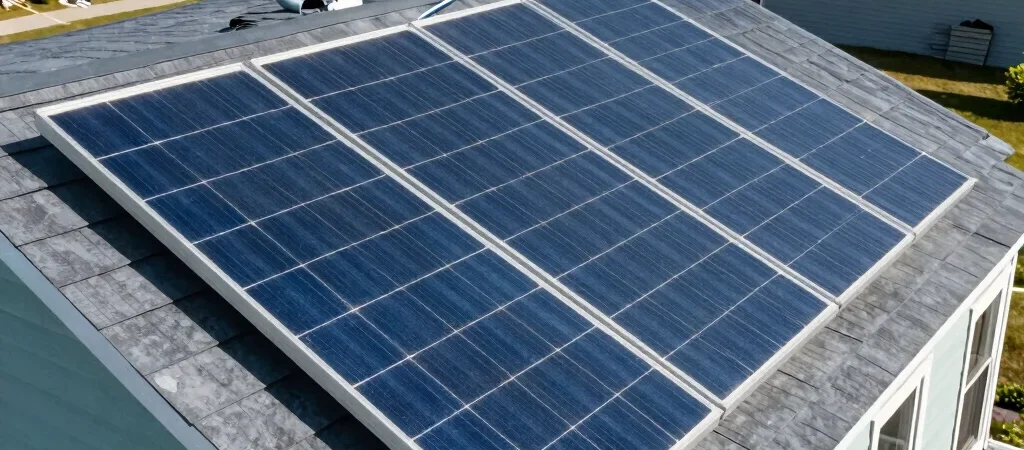
On a bright afternoon, sunlight lands on a rooftop panel and sets a chain of events in motion. The panel produces electricity, but that electricity still needs to be converted and routed before household appliances can use it. Understanding those steps makes the equipment on a solar system easier to recognize.
What a solar cell does
A solar cell is made from semiconductor material, commonly silicon. When light reaches it, the cell releases and directs tiny charged particles, creating direct-current electricity. More sunlight can mean more production, but clouds, shade, temperature, and the panel’s orientation also affect how much electricity is made.
Cells are connected inside a panel, and panels are connected into an array. Think of the array as the part that gathers sunlight and produces electricity; it does not, by itself, make that electricity compatible with the wiring in a typical home.
Why the inverter matters
Solar panels produce direct current, or DC. Most household circuits use alternating current, or AC, so an inverter changes the electricity from one form to the other. Some systems use a central inverter for the array, while others use smaller inverters attached to individual panels or pairs of panels.
That conversion is one reason a solar installation includes more than panels on a roof. Wiring, protective equipment, and the connection to the home’s electrical panel help move and manage the power safely. The exact layout depends on the system design.
Where the electricity goes
When the panels are producing electricity, the home can use that power as appliances need it. If production is greater than the home’s immediate use, a grid-connected system may send the excess to the utility grid, depending on local rules and system setup. When the panels are not producing enough, the home can draw electricity from the grid.
A grid-connected system does not necessarily keep the lights on during a power outage; many systems shut down unless they have equipment designed for backup operation. The useful mental picture is a sequence: sunlight, panel, inverter, home wiring, and—when connected and permitted—the wider grid.